The number you wrote down last night has to be there when your pulse jumps.
How to Prepare for a Negotiation: Four Things to Know Without Looking
To prepare for a negotiation, research on paper first: the going rate, what the other side needs and can’t move, and your real alternative if this falls through. Then learn four things by heart: your walk-away figure, your target and first number as a pair, your opening line, and one trade you’re ready to offer. Leave the rest to your own words.
We found no study comparing negotiators who memorized their numbers with ones who read them from notes, and notes are fine to bring. Nerves are the reason to know the four cold. In Brooks and Schweitzer’s 2011 lab studies, anxious negotiators made lower first offers and left the bargaining earlier.

The situation
The hiring manager says, “Before we put the offer together, what are you looking for in base?” Your heart rate goes up, and the figure you settled on last night is in a notebook you can’t open now. You give a rounder, lower number, the first one that comes to mind.
The four items are for those seconds. First, the walk-away: the worst deal you would still accept, set from your real alternative and never said aloud. Second, your two numbers as a pair: the target you aim for, and the first number you say if you open, a little above the target, with one source you can name. Third, the opening line, which says why you are there. Fourth, the trade you ask for if the main number can’t move.
WALK-AWAY (private, never said aloud)
Below [$X], I take [my alternative].

TARGET AND FIRST NUMBER
I aim for [$Y]. I open at [$Z], because [one source you can name].

OPENING LINE
“I’m glad we’re talking. I want this role, and I’d like to agree on a package that reflects [the scope of the role].”
(If they have already made an offer, start with “Thank you for the offer.”)

THE TRADE
If they say [the base is fixed], then I accept [their base] in exchange for [a six-month review to $W against agreed goals, in writing, or a signing bonus of $B].
The paper half: what to research and leave on the page
Most preparation is reading, and it can stay written down. Fill one page before you learn anything by heart. For the market, find two independent sources for the going rate, such as a salary database and a posted range for the same role. Note their constraints: the budget cycle, the pay band, how soon they need someone. Add their alternative, meaning how hard you would be to replace. Your own alternative is what you will do if this falls through, and the walk-away comes from it. List every term besides the headline number, such as start date, title and remote days, so the trade has somewhere to come from.
Write down the two objections you expect, such as “that’s above our band,” with one sentence you would say back to each. The same page works for a rent renewal, where the walk-away becomes the rent at which you move. Read it the night before; only the four items on the card need to come out without looking.
What your target and first number do once the talking starts
Galinsky and Mussweiler had people negotiate a single price, face to face and by email, in three experiments published in 2001. First offers strongly predicted where the price settled. The advantage disappeared when the person receiving the offer thought about information that cut against it, and in the third experiment that information was the receiver’s own target.
A 2025 synthesis by Petrowsky and colleagues pooled 374 effects from 90 studies with 16,334 participants. Making the first offer helped on average, and more ambitious first offers went with better agreements. They also went with more impasses and left the other side feeling worse about the deal, and all these effects shrank as deals involved more issues. In a job offer the other side may be your next manager, so open ambitious and defensible.
Galinsky, Mussweiler and Medvec compared negotiators who focused on their target with ones who focused on their lower limit, in three experiments reported in 2002. The target group got objectively better deals and felt less satisfied with them. In the last experiment, a reminder of their lower limit after the negotiation raised their satisfaction. So keep the target in mind while you talk, and judge the result against the walk-away afterward.
In the Galinsky role-plays, thinking about your own target blunted the other side’s number. Having it by heart should make that easier in the moment, though that last step is our inference.
Nerves pull first offers down and make recall less reliable
Brooks and Schweitzer made some participants anxious in the lab before a negotiation or a bargaining task, across four studies published in 2011. Compared with people in a neutral state, the anxious ones expected less, made lower first offers, left earlier and ended with worse outcomes. Those who felt more able to handle the task were hurt less.
Shields and colleagues’ 2017 meta-analysis combined 113 studies with 6,216 participants. In the 31 studies that applied stress just before or during recall, memory was impaired, more for emotionally charged material than for neutral. That effect was small, and it came from lab material such as words and pictures and lab stressors such as a mock job interview. A salary figure you care about is probably closer to the charged material, though the studies tested material people had been given to learn.
Pressure may also eat into the working memory you would use to work out a figure on the spot. In a 2005 study of math under pressure, Beilock and Carr found that only people with high working-memory capacity got worse, and only on the hardest problems. They concluded that pressure uses up the working memory those people rely on.
The best-known test of how practice and stress interact is a 2016 study by Smith, Floerke and Thomas. They had 120 Tufts University students learn a list of words and pictures by restudying it or by taking practice recall tests. A day later, half of each group gave an impromptu speech and did mental arithmetic before judges. Five minutes in, stress made no difference. On a second test about 20 minutes later, stressed students who had restudied recalled fewer items than calm ones, and among those who had practiced recall, stress made no measurable difference. That is one lab study of lists, and a 2017 commentary by Wolf and Kluge noted that the recall group remembered more overall, so stronger learning in general may explain why that group held up.
Bring notes, and know the four without them
Notes are fine to bring. Linking the two kinds of research is our own reasoning, since no study we know of has compared negotiators who memorized their numbers with ones who read them from a page. If Galinsky and colleagues are right that a ready target and first number matter, and Shields and colleagues are right that stress makes recall less reliable, four items you can say without looking are worth a few days of practice.
Write the trade as an if-then line
When they say the base is fixed, you need something to ask for next that is worth money. A review on its own promises only a conversation, so tie it to a figure: “If they say the base is fixed, then I accept their base in exchange for a six-month review to $118,000 against goals we agree now, in writing.” A signing bonus can work too, since it may come from a different budget.
Trötschel and Gollwitzer (2007) found in three experiments with negotiating pairs that if-then plans helped negotiators act on their goals. Those goals concerned agreements that served both sides, so the finding says nothing about holding a walk-away.
Learn the four by testing yourself over several days
Roediger and Karpicke (2006) had students learn prose passages by reading them again or by recalling them from memory. Five minutes later, re-reading did better. Two days and a week later, the recall group remembered substantially more. Re-reading had made the other group more confident, and they remembered less. Cepeda and colleagues reviewed 317 verbal learning experiments in 2006 and found that the best gap between practice sessions grows with how long you need to remember. For a meeting next week, that means a few short recalls across several days.
Write the four items on a card. Starting three or four days out, say each item aloud once a day with the card face down, then check it (saying it aloud is our own advice). Attach each figure to its reason, since a number like $122,000 has nothing to picture. Do the last recall on the morning of the conversation and put the card in your pocket.
Learning the four items on places you know
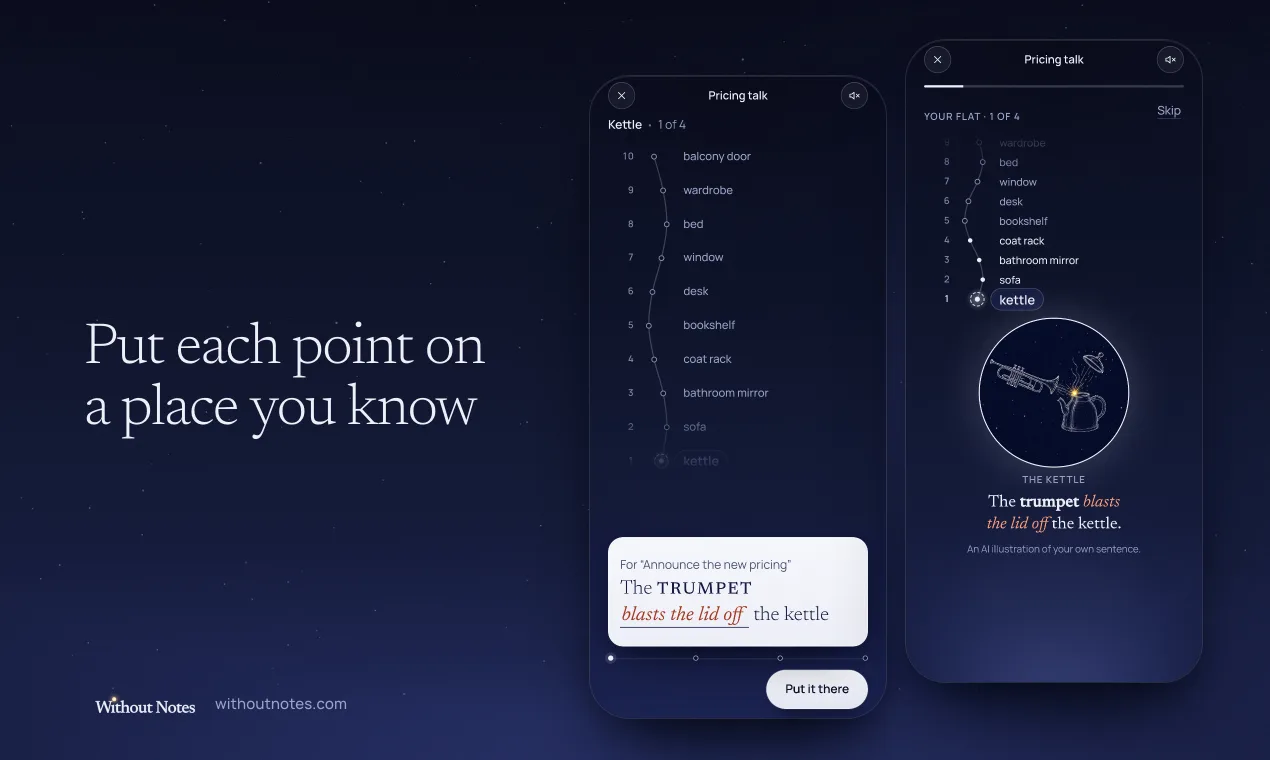
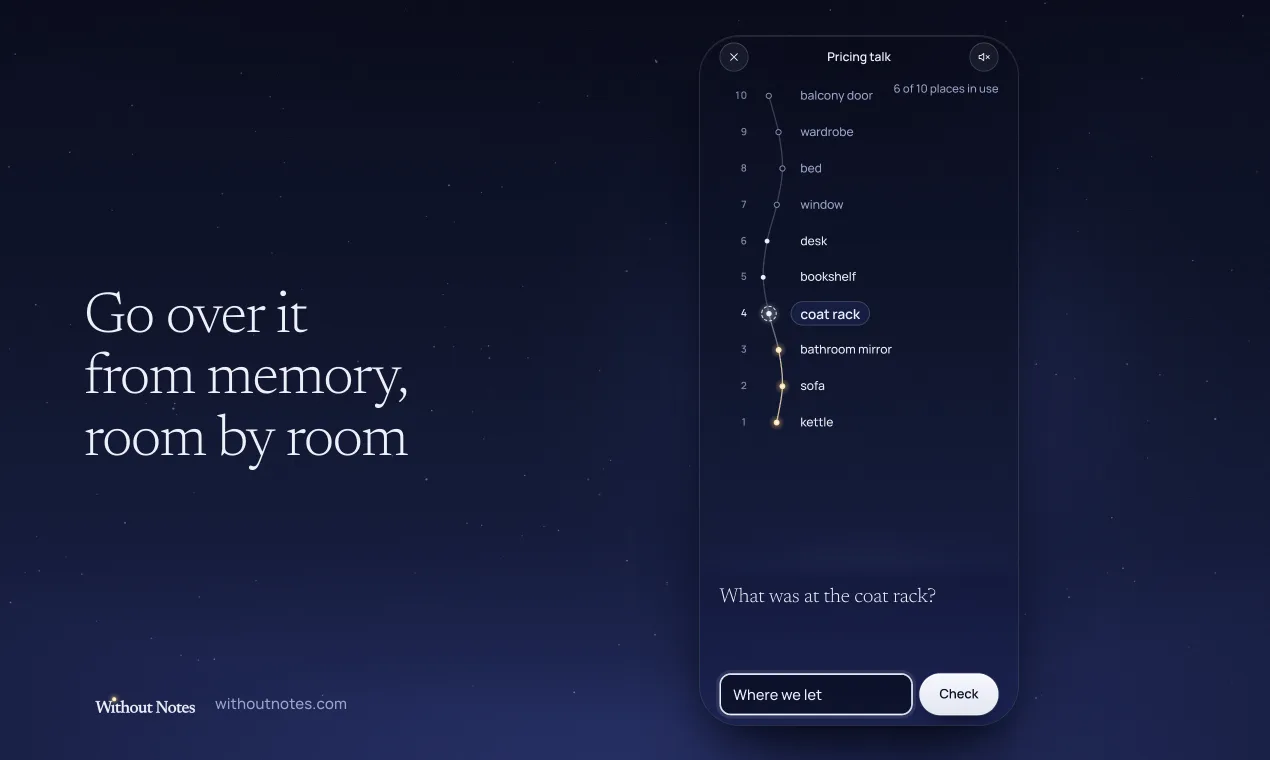
Our company, BD Nova UG (haftungsbeschränkt), also makes Without Notes, an app for learning by heart what you need to say. You put each point on a place you know well, such as a room in your home, then go over the points from memory, place by place. This is the old memory-palace method. Numbers are harder to place than points, so give at most two figures a scene of their own, or keep them on your card. A place holds the point of your opening line and leaves its exact words to you, so say the line itself from the card.
The memory palace on its own has less evidence behind it than its fans suggest. For young adults the measured advantage is small and uncertain. Going over points from memory is better supported: Yang and colleagues’ 2021 review of 222 classroom studies found that quizzing raised achievement. You can start with ten words and no signup, and learn ten of your own things for free.
Try Without Notes for negotiation
Without Notes is made by BD Nova UG, the company behind NegotiateIt.
How it sounds
The final interview. The hiring manager asks before the offer is written.
Why this works: The number and its reason were learned together, so they come out together when you’re nervous.
A different call. The hiring manager names a figure before you do.
Why this works: You answer their figure with your first number and ask what supports theirs. With your $118,000 target in mind, their $100,000 is less likely to become the number the call works from.
The offer stands at $112,000. Your walk-away is $108,000 and your target $118,000.
Why this works: You wrote this if-then line at home for this sentence, and $112,000 sits above your walk-away, so the decision was made before the call.
What not to say
Don’t recite. A memorized paragraph sounds like one, and the other side starts waiting for you to finish.
Don’t say your walk-away figure out loud. It is on the card so you can recognize it. Once spoken, it tends to become the number the other side aims for.
Try it against someone who pushes back
Say your first number to PatriciaFree scenario · sign up in under a minute · a VP who cites budget
Common mistakes
- Preparing only by re-reading. In Roediger and Karpicke’s experiments it raised confidence, yet two days and a week later those students remembered less than the ones who had practiced recall.
- Choosing a first number you can’t explain. The first “where does that come from?” moves you off it. The 2025 synthesis also linked more ambitious first offers to more impasses, so the higher you open, the more you need a reason you can say.
- Leaving the trade undecided, so “that’s our final offer” ends the call on their terms.
Questions people ask
What should I research before a negotiation?
The going rate from two independent sources, the other side’s constraints and deadline, both sides’ alternatives, every term besides the headline number, and the two objections you expect. All of it can stay on paper.
How far in advance should I prepare for a negotiation?
Do the research as soon as the conversation is scheduled, and start learning the four items three or four days out, with one short recall a day. A 2006 review by Cepeda and colleagues found that the best gap between practice sessions grows with how long you need to remember.
Is it okay to bring notes to a negotiation?
Yes. We found no study showing that notes make a negotiator look less credible, and on a phone or video call a card beside the screen is normal. Know the four items without them as well.
Should I memorize a negotiation script?
No. Learn the four items and talk through the rest. The figures should be exact and the opening line close to word for word. Practice the back-and-forth in role-play, where you can’t predict what they’ll say.
How do I calm my nerves before a negotiation?
Decide your first number before the call, so anxiety has less room to pull it down, and practice it against someone who pushes back. That advice follows from Brooks and Schweitzer’s 2011 lab studies, where anxious negotiators made lower first offers. In separate studies published in 2014, Brooks found that people who reappraised their nerves as excitement, for example by saying “I am excited” out loud, did better at karaoke, public speaking and math than people who tried to calm down. None of those tasks was a negotiation.
What should I do if my mind goes blank in a negotiation?
Pause, and look away for a second if it helps. In a set of lab experiments published in 1998, Glenberg and colleagues found that people often look away on harder questions, and that looking away improved their answers. Then ask a question, such as “What’s behind that number?”, or go back to your opening line. Say your first number only if it is your turn to name one.
Sources
Practice the real thing
The techniques this uses
Drill it until it’s a reflex
Say your first number to PatriciaFree scenario · sign up in under a minute · a VP who cites budget